AI Reminds Me What Good Collaboration Looks Like
Report early, give useful recommendations instead of dead ends, provide enough context for others to work independently, and know when to stop thinking and start acting are healthy habits.
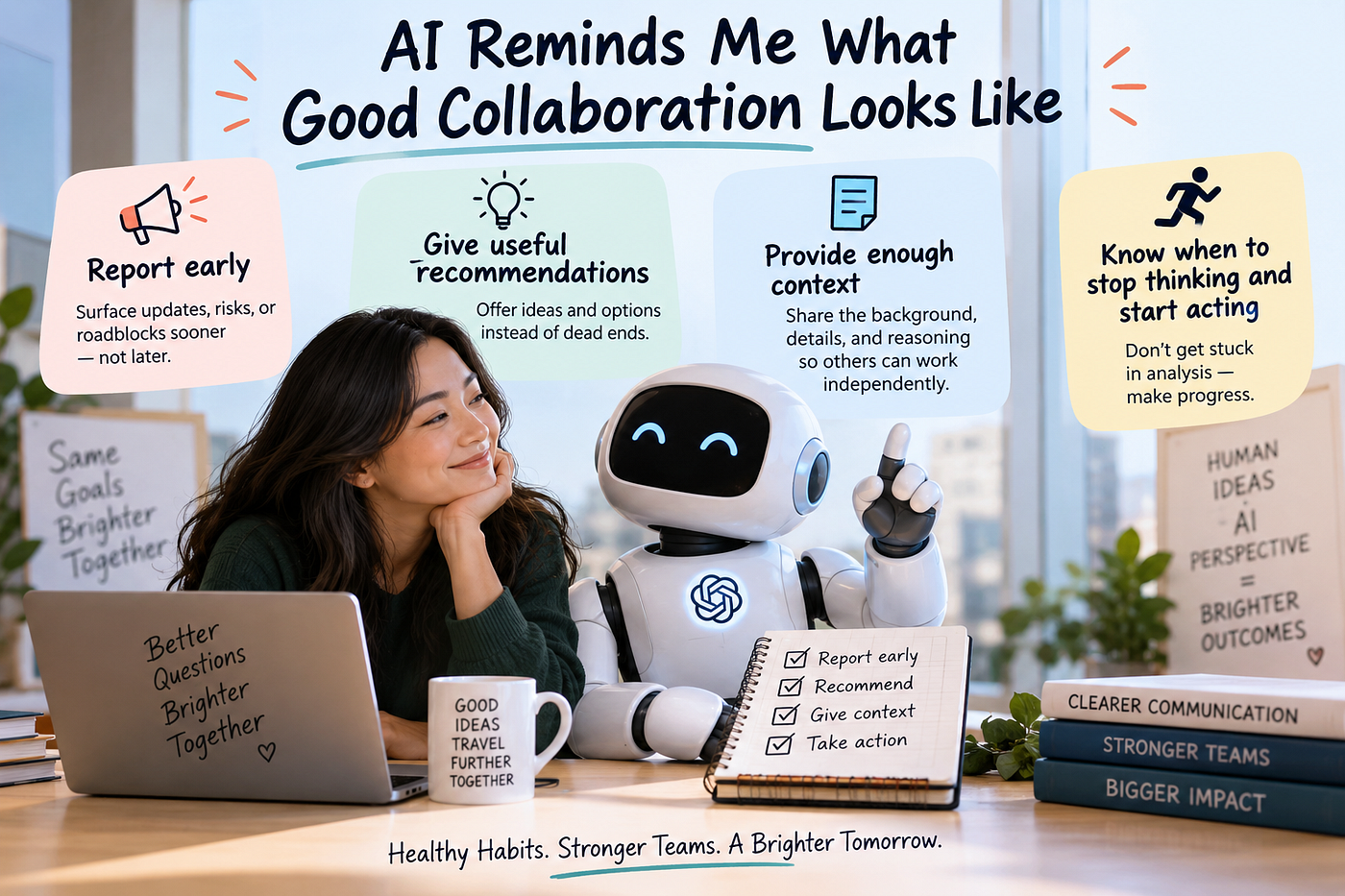
Working with AI models is surprisingly similar to how I should work with people. This year, I’ve been leveraging AI in my work a lot as a software engineer. Our workflows have evolved several times, actually: we began two or three years ago with a simple question-and-answer model, then moved to in-place code editing and code completion, and eventually arrived at an agentic workflow where coding agents can code an entire feature for you. Along this journey, I picked up several lessons that work for both LLMs and human colleagues.
Report early and often
When I prompt an agent to fix a bug or develop a feature, I expect it to get back to me as early as possible with its findings and a plan. I hate staring at endless tool-calling logs, only to discover later that it found nothing or completely misunderstood my request. A better scenario would be a fast, responsive response, like: “Hey, if I understand correctly, the bug is about a button being placed incorrectly on mobile but not on desktop, correct? Let me go verify that.” That is much better than: “Hey, I’m testing the desktop viewport all over the place but finding nothing. Let me just try editing the values based on my best guess.”
An early response shows that you acknowledge the request, have formed an initial judgment, and have a direction in mind. If you receive a task from your boss, this allows them to see that something is already happening and adjust the direction immediately if necessary, avoiding costly rework.
Give constructive recommendations instead of dead ends
Compared to AI, we humans are more defensive and better at pointing out problems than finding solutions. In fact, one of the most unproductive things you can do is complain in your workplace without suggesting what the solutions might be. I mean, there are horrible environments where you’d better mind your own business, but there are also healthy ones where you should try to contribute proactively to making the workplace better for your own sake.
Assuming you do, then like a good AI model, try to give recommendations whenever you receive a task, a request, or any professional problem in general. For example, instead of complaining, “This codebase is dirty, full of hacks, and starting the development environment is a slow, horrifying experience,” the better reaction would be: “The codebase has high technical debt. A seemingly simple change is actually taking longer to implement and test. Do you want me to add refactoring time to the estimate or just find a workaround?”
Or: “I’m allocated to another project this week. Could you please discuss this with PM X? If they agree, I’ll spend my time on this problem.” That is better than saying, “Sorry, you might have to wait until next week, when I have the allocation. Please book me beforehand next time.”
This article is also available in Substack: https://tien8436.substack.com/p/ai-reminds-me-what-good-collaboration
Consider what your colleagues need to know to do their tasks efficiently
A good Jira ticket tells me everything I need, or at least where to look, to accomplish the task: reproduction steps, Figma links, business context, acceptance criteria, and so on. A bad one just gives me a description.
When requesting a code review, proactively commenting on noteworthy parts of your own code and explaining what you did and why will help your reviewers focus on important details rather than on spacing or commas.
When handing a ticket over to QA, a small comment in the ticket itself mentioning what you did, the decisions made during team discussions, a screenshot, or a URL will help QA catch up with the context more easily.
This is also true if you’re a boss delegating tasks. If you want me to do the work efficiently, please provide not just the request but also the context, reasons, and goals behind it.
By the way, do you see how this parallels working with AI?
Being thoughtful and being hesitant are not the same thing
Do you know what I hate about Sonnet 5 High or Extra Thinking mode? It keeps calling tools nonstop and spends all my tokens on irrelevant things.
“Let me read this method. Oh wait, another file is imported. Let me read that too! I need to gather all the relevant context before making a decision.”
This is not just inefficient; it’s costly. The same thing applies to us. In professional work and in life, sometimes it’s better to just do something as soon as we have enough concrete information rather than obsessing over perfection. Similarly, when the PMs and clients are in hurry situations, don’t try to find the root cause at all cause or refactor the code, just make it work first.
None of these are new lessons invented by AI. Good communication, proactive reporting, considerate delegation, and knowing when to stop thinking have always mattered at work.
What changed for me is that working with AI made the consequences much faster to see. When an agent rambles without reporting, I get annoyed. When I give it insufficient context, I get a bad result. When it only points out a problem without suggesting what to do next, it is not very useful. When it thinks forever instead of acting, I want it to just get on with the task.
Then I realized: my colleagues probably feel the same way about me.
It seems that learning how to work effectively with AI is not completely different from learning how to work effectively with people after all.